

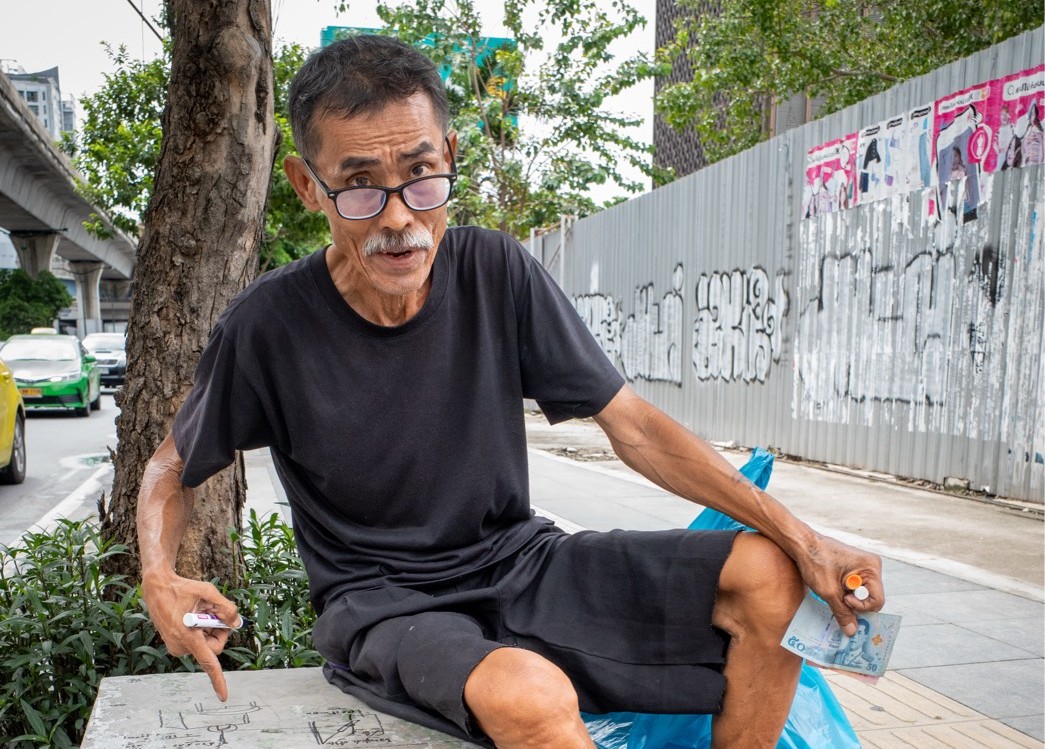
Cover Photo: Pichai Rattanapornchai pauses to gesture toward his work on Sukhumvit Road in 2023. / Neil Shelley
Pichai Rattanapornchai, a homeless man responsible for covering Bangkok with countless graffitied glyphs somewhere between art and insanity for over two decades has died.
While untold numbers encountered Pichai’s profuse words and drawings inked onto utility boxes, columns, and sidewalks across the capital city, few knew the name of the man who brandished permanent markers on any public surface to draw a mix of intricate mind maps, architectural outlines, arcane formulas, and dark conspiracies.
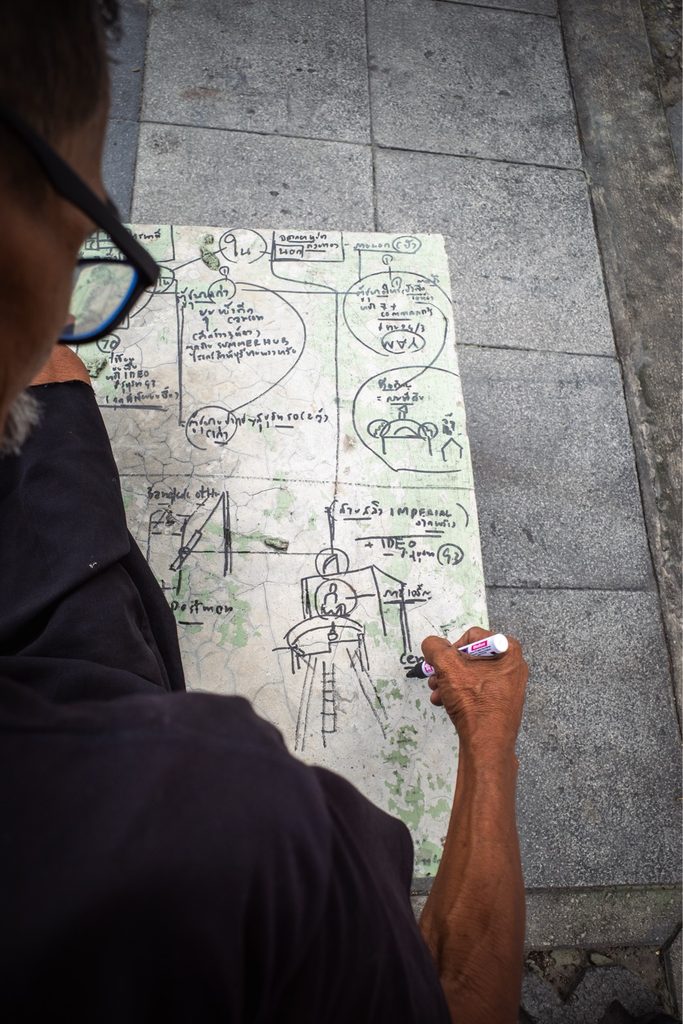
Photo: Pichai would sometimes work from notes to create his murals. / Neil Shelley
Pichai, whose work broke through to a mainstream audience at the 2020 Bangkok Art Biennale, was 62 when he died on Aug 13, according to writer Stephen Lorriman, who had befriended the artist in recent years.
Reached for comment Tuesday, Khlong Tan police were unable to confirm the details nor cause of death. Pichai had been visibly ill for many months.
“He was an artist in the pure sense. He was compelled to create,” Lorriman said. “But he never considered himself an artist. He believed he was doing a social good by warning people about those in power. And sure he was mentally unwell, but most times he could switch off his ‘theories.’”
Homeless man on quest to scribble Illuminati conspiracies on Ratchathewi bridge?
Almost every day for over 20 years, Pichai woke early to hunch for hours over his drawings before the hottest part of the day. In recent years, he mostly drew on the sidewalks of Pridi Banomyong Road. He seemed to favor Horse brand permanent markers.
In one stroke, he might ink ominous acronyms such as “CIA” and “CP,” or cosmological org charts in the spirit of sak yant, only on concrete. While writing primarily in Thai, Pichai included many English references to everything from The Eagle’s “Hotel California” to foreign currencies and Japanese retail chain MaxValu.
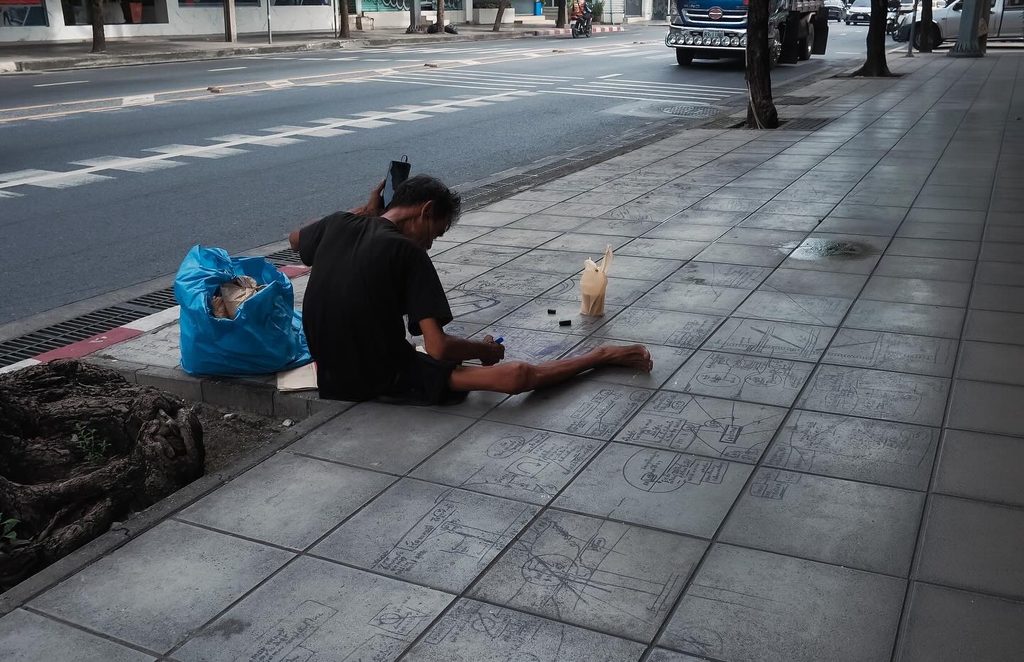
Photo: Pichai Rattanapornchai at his work. / Neil Shelley
He covered kilometers of Bangkok’s sidewalks in tiny script resembling an electrician’s schematics or quantum physicist’s blackboard.
In recent years, the craft of his drawings had evolved to include more complex 3D perspectives, though they continued to operate at the liminal threshold between art and mental illness.
Pichai himself expressed doubt that he was an artist and instead referred to his work as investigatory “notes” into the death of his family in a 2020 YouTube video produced by Raphael Treza.
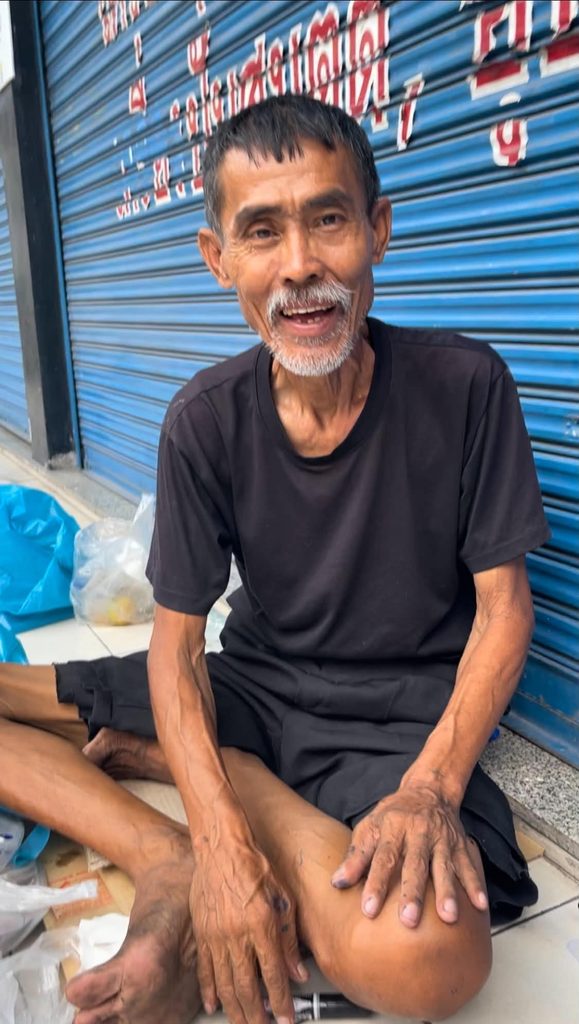
Photo: Fingers stained black with ink, Pichai smiles and rests one hand on a Horse brand permanent marker Oct. 12, 2023 along Pridi Banomyong Road. / Stephen Lorriman
“I was searching for the cause of the deaths of my family. I suspected they drank poison. I promised myself that since I had nothing to do with my life, I would collect clues and evidence: dates, timetables, contracts, and so on,” he told Treza through an interpreter.
Pichai also said he had been a soldier before being jailed for an undisclosed offense prior to becoming homeless.
On the street, Pichai could be volatile, screaming at passers-by and behaving angrily if approached. But he would quickly shift into a reasonable, rational, and friendly tone once he didn’t feel threatened.
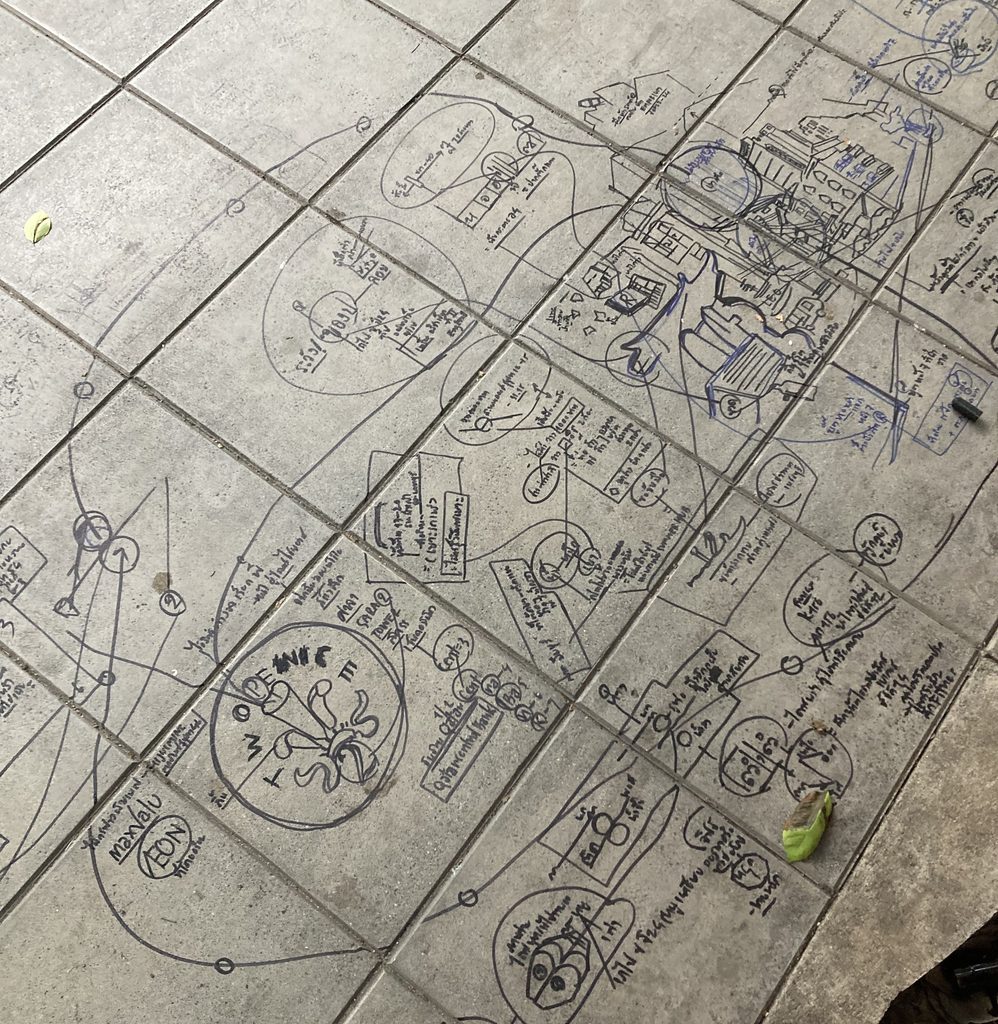
Photo: A two pence coin and the Qatar Central Bank feature among a myriad of references on one small span of Pichai’s work created in 2024. / John R.
Over the years, he became referred to colloquially as “The Mad Professor” on social media.
“I found his work astonishing but, yes, it was undoubtedly the work of a deeply paranoid and troubled mind,” Lorriman said. “The work displays the symptoms … of schizophrenia. But he could easily communicate over the everyday, like music and food, etc.”
While Pichai was believed to have an older sister living northwest of Bangkok in Pakkret, there were no known funeral arrangements.